Count the real cases
Include every suitcase, cabin bag, stroller or equipment item and assume that luggage may need to remain out of sight between stops.
Booking decision guide
The right Balkan rental car is the smallest category that carries everyone comfortably and suits the longest real driving day.
Updated
Plan the trip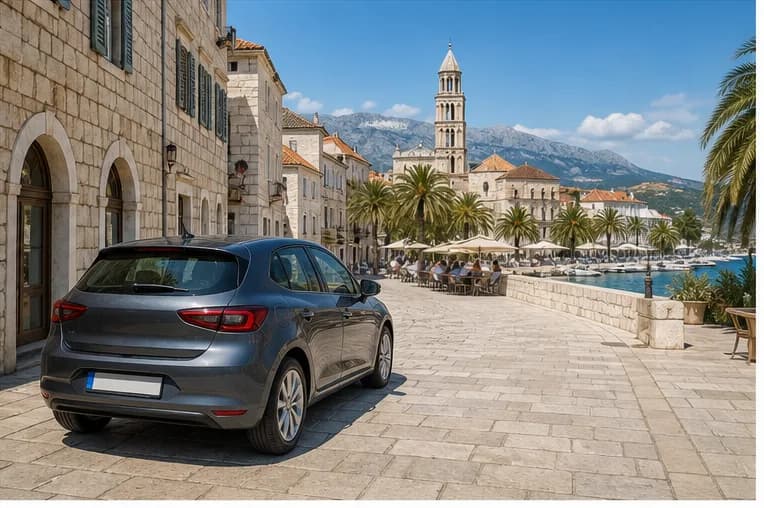
Start with
Passengers, cases, seats and the longest day
Compact helps
Old-town approaches, bayside roads and hotel parking
Upgrade for
Real luggage, comfort or passenger needs
Confirm
Transmission, road limits, borders and ferry permission
Balkan routes move between airports, old towns, coastal roads and mountain viewpoints. The car category should start with the people and cases travelling together, then be tested against the longest drive and the places where it will be parked. A category image or a familiar model name is not a guarantee of boot shape or passenger comfort.
Useful next steps: the full vehicle-fit guide, the luggage-fit checklist, the seats and driver guide
Include every suitcase, cabin bag, stroller or equipment item and assume that luggage may need to remain out of sight between stops.
A car that technically fits on the first transfer can become tiring across a week of luggage changes, heat and longer coastal or inland legs.
Child seats, extra drivers and a full passenger load can move the practical choice above the smallest category.
Compare the supplier's category, transmission and luggage wording. A displayed example vehicle is not necessarily the exact model.
Compact categories can reduce the workload around old-town approaches, waterfront parking and narrow accommodation access. That advantage matters only when the boot and cabin fit the group. Choose compact for genuine manoeuvrability, not as a reflex that leaves luggage or passengers cramped on the longest day.
Useful next steps: the automatic or manual guide, Kotor car hire, Dubrovnik car hire
A smaller footprint can help when the trip combines historic centres, bayside roads and accommodation with limited parking.
For two people with lighter luggage, a compact category can leave useful room without carrying unnecessary size through every town.
If automatic transmission matters, select it explicitly and check that it is included in the booked category rather than a desk request.
Use the accommodation address and parking instructions to test whether the category is easy to use at the actual destination.
A touring category, estate or SUV can be justified by the group, the luggage, the road length or the need for a more relaxed cabin. It does not automatically make mountain or unsealed-road travel permitted. Confirm the agreement and choose the upgrade around a specific use rather than a vague idea that bigger is safer.
Useful next steps: the luggage-fit checklist, the Croatia and Montenegro road-trip planner, the toll and road-charge guide
Extra cabin comfort can matter when the itinerary links several countries or combines coast and inland roads across one rental.
Families and groups should test the complete luggage and seating requirement before selecting the category, including room for child seats.
A higher seating position may feel useful, but driver confidence, visibility and the permitted route matter more than the badge on the bonnet.
Price the convenience of extra space against old-town garages, hotel access and narrow coastal approaches where a large vehicle creates more work.
The most expensive category mistake is choosing a vehicle before checking the route permissions. Croatia, Montenegro, Bosnia and Herzegovina, Albania, Serbia, Greece and ferry segments can each have supplier-specific conditions. Ask for approval for the exact countries, ferry and road types, then record the answer with the booking.
Useful next steps: the cross-border Balkans guide, the Croatia and Montenegro permission guide, the ferry guide
Name every country and ask which papers, cover and fees apply. Neighbouring borders are not automatic permissions.
Confirm whether the category may board the intended ferry and whether the vehicle must return to its collection island or country.
Do not infer permission from an SUV label. The agreement can exclude unsealed, restricted or remote roads regardless of vehicle size.
Check fuel, mileage, toll devices and administration fees because the route can cross several systems in one rental.
Before payment, the category should answer five practical questions: does it fit the people and bags, can the main driver use it confidently, can it reach the permitted route, can it be parked at the stays and can it return without a rushed final day? If one answer is unclear, compare another category or ask the supplier before confirming.
Useful next steps: the rental-counter checklist, the condition-photo guide, the whole-cost calculator
Test the cases, seats and equipment together rather than relying on a generic passenger number.
Match transmission, visibility and size to the driver's experience, the side of the road and the planned workload.
Save written border, ferry and road permission with the voucher and check whether the return changes the answer.
Allow for fuel, inspection, traffic, photographs and the branch's opening or key-drop process.
Use the answers to identify the checks that matter. Check the selected supplier terms and current local rules before booking.
Usually the smallest category that comfortably fits the full group and luggage, with the transmission and comfort needed for the longest day. Confirm parking, road, border and ferry conditions before choosing an upgrade.
Not automatically. Choose around passengers, luggage, comfort and permitted roads. An SUV label does not grant permission for unsealed, restricted or cross-border travel.
It can be worthwhile when the driver is more confident with an automatic on unfamiliar, busy or hilly roads. Select it explicitly because availability and category terms vary.
Count the real cases and seats, check the supplier's category wording and leave a margin for comfort. Use the luggage-fit guide before selecting a rate.